AKC Toy Group · No. 38 in 2025
How to identify a Pug
The Pug is a square, cobby toy dog, ranked No. 38 by the AKC in 2025. Look for deep wrinkles over a short, square muzzle, large round eyes and a tail curled tightly over the hip. Pugs are fawn or black only, and fawns have a black mask and a black line down the back.
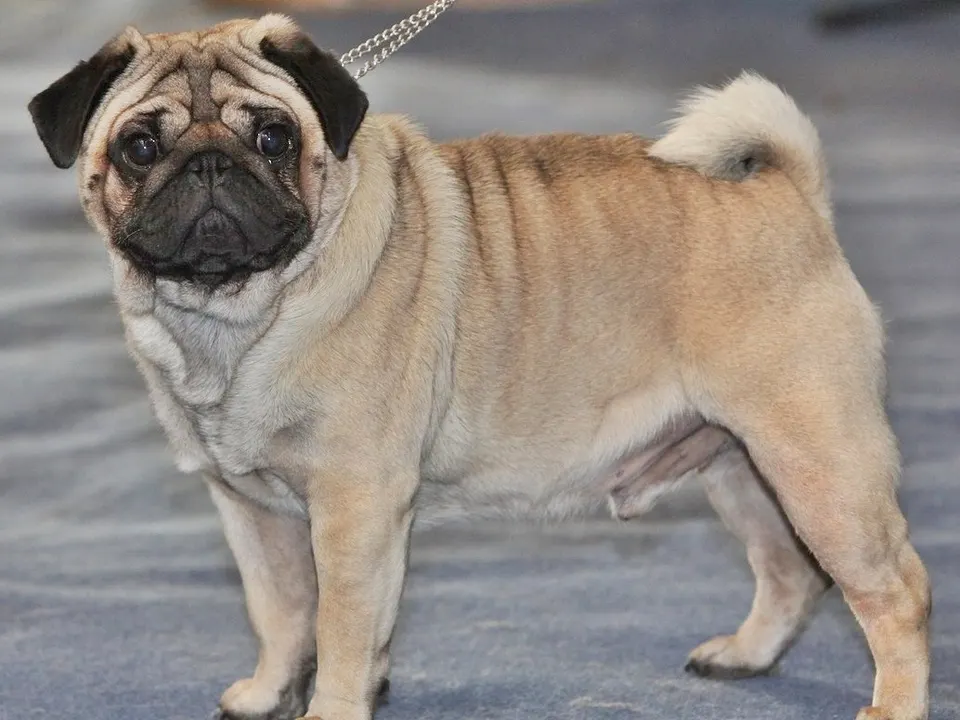
Field marks
These four marks are the ones the game gives you as clues. They paraphrase or briefly quote the AKC Pug standard.
- “Large and deep” wrinkles above a “short, blunt, square” muzzle
- Tail “curled as tightly as possible over the hip”; “the double curl is perfection”
- Fawn or black only; fawns show a black mask, ears and a black “trace” down the back
- “Square and cobby” body; small, soft ears “like black velvet” and very large, round eyes
Tell them apart
Pug or French Bulldog?
Check the ears and the tail. A Pug has small, soft, black velvet ears and a tail curled tightly over the hip. A Frenchie has large, erect bat ears and a short tail. Pugs are only fawn or black, while Frenchies are never black.
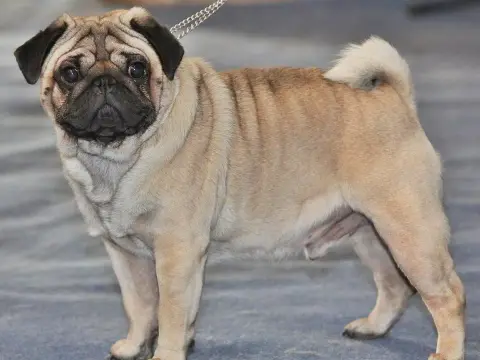
Pug
- “Large and deep” wrinkles above a “short, blunt, square” muzzle
- Tail “curled as tightly as possible over the hip”; “the double curl is perfection”
- Fawn or black only; fawns show a black mask, ears and a black “trace” down the back
- “Square and cobby” body; small, soft ears “like black velvet” and very large, round eyes
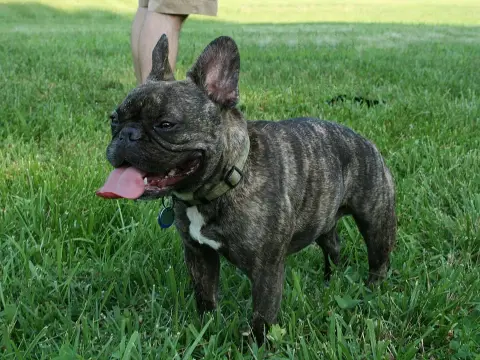
- “Bat ear, broad at the base, elongated, with round top,” carried erect
- Large, square head with a soft roll of wrinkles over an “extremely short nose”
- “Roach back,” with the loin higher than the shoulder
- White, cream, or fawn, with brindle or piebald patterns; never black, blue, or merle
Test your eye
One photo, four names, ten dogs a day. Free, no sign-up.
More Companion & Toy breeds
- Boston Terrier
- Bull Terrier
- Bulldog
- Cavalier King Charles Spaniel
- Chihuahua
- Dalmatian
- French Bulldog
- Havanese
- Miniature Schnauzer
- Pomeranian
- Poodle
- Shiba Inu
- Shih Tzu
- Yorkshire Terrier