AKC Working Group · No. 66 in 2025
How to identify a Great Pyrenees
The Great Pyrenees is a large white livestock guardian, ranked No. 66 by the AKC in 2025. Check the hind legs for double dewclaws, which the standard expects. The coat is long and flat with a ruff, the tail is plumed, and any markings are gray, badger, reddish brown or tan.
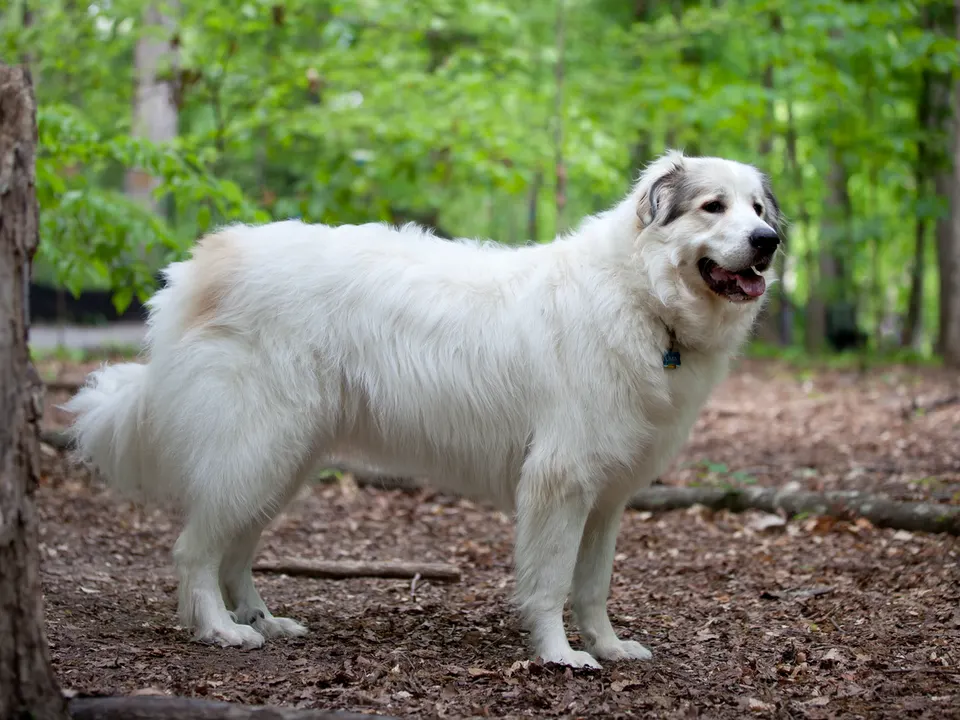
Field marks
These four marks are the ones the game gives you as clues. They paraphrase or briefly quote the AKC Great Pyrenees standard.
- White or mostly white, sometimes marked with gray, badger, reddish brown or tan on the head, ears and tail
- Double dewclaws “on each rear leg”
- “Well plumed” tail carried low, or over the back (“making the wheel”) when roused
- Small V-shaped ears with rounded tips, carried “low, flat, and close to the head”; long, flat outer coat with a ruff
Tell them apart
Great Pyrenees or Samoyed?
Check the coat and the ears. A Samoyed’s outer coat stands straight out from the body, its ears are erect and its lips curl into a smile. A Great Pyrenees has a long, flat coat, small V-shaped ears that hang close to the head and double dewclaws on the hind legs.
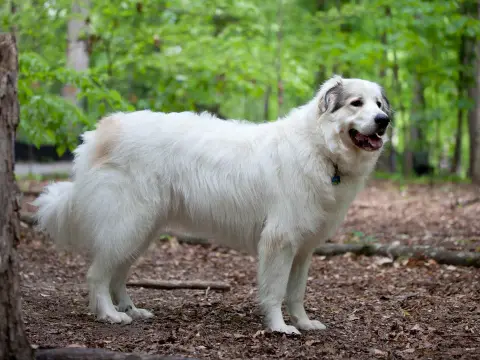
Great Pyrenees
- White or mostly white, sometimes marked with gray, badger, reddish brown or tan on the head, ears and tail
- Double dewclaws “on each rear leg”
- “Well plumed” tail carried low, or over the back (“making the wheel”) when roused
- Small V-shaped ears with rounded tips, carried “low, flat, and close to the head”; long, flat outer coat with a ruff
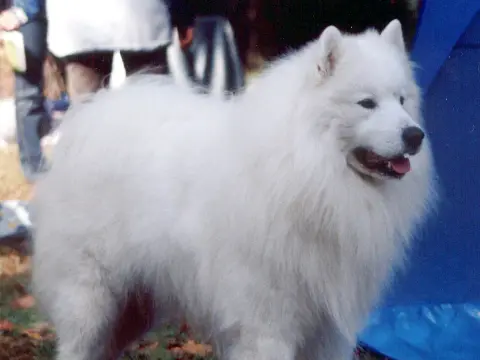
- Pure white, white and biscuit, cream, or all biscuit only
- Outer coat “stands straight out from the body,” with a ruff framing the head
- Black lips “slightly curved up at the corners” for the “Samoyed smile”
- Erect, triangular ears with slightly rounded tips; tail carried over the back
Great Pyrenees or Newfoundland?
Check the color and the hind legs. A Great Pyrenees is white or mostly white and has double dewclaws on each rear leg. A Newfoundland is black, brown or gray, or the white-and-black Landseer, with a separate black saddle.
Great Pyrenees
- White or mostly white, sometimes marked with gray, badger, reddish brown or tan on the head, ears and tail
- Double dewclaws “on each rear leg”
- “Well plumed” tail carried low, or over the back (“making the wheel”) when roused
- Small V-shaped ears with rounded tips, carried “low, flat, and close to the head”; long, flat outer coat with a ruff
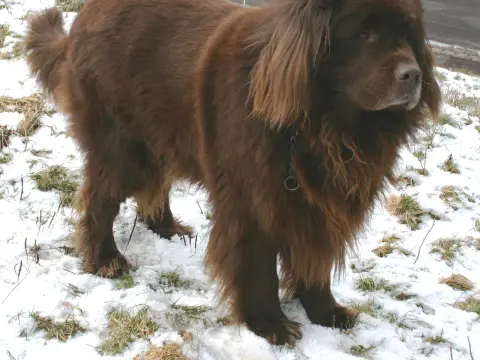
- Massive: about 28 inches for dogs and 26 for bitches, with a broad head
- Black, brown, gray, or the white-and-black “Landseer”
- “Flat, water-resistant, double coat” that is coarse and moderately long
- Small triangular ears with rounded tips; the tail hangs straight and “does not curl over the back”
Test your eye
One photo, four names, ten dogs a day. Free, no sign-up.
More Working & Herding breeds
- Akita
- Alaskan Malamute
- Australian Shepherd
- Belgian Malinois
- Bernese Mountain Dog
- Border Collie
- Boxer
- Cane Corso
- Cardigan Welsh Corgi
- Collie
- Doberman Pinscher
- German Shepherd Dog
- Great Dane
- Newfoundland
- Pembroke Welsh Corgi
- Rottweiler
- Saint Bernard
- Samoyed
- Shetland Sheepdog
- Siberian Husky